Details
-
Type:
Bug
-
Status: Closed
-
Priority:
 Minor
-
Resolution: Fixed
-
Affects Version/s: V3.10.0.0
-
Fix Version/s: V3.10.0.4, V3.10.3.0 (trunk)
-
Component/s: Core
-
Labels:None
-
Account:SPC EthernetIp Core (SPCETHERNET)
Description
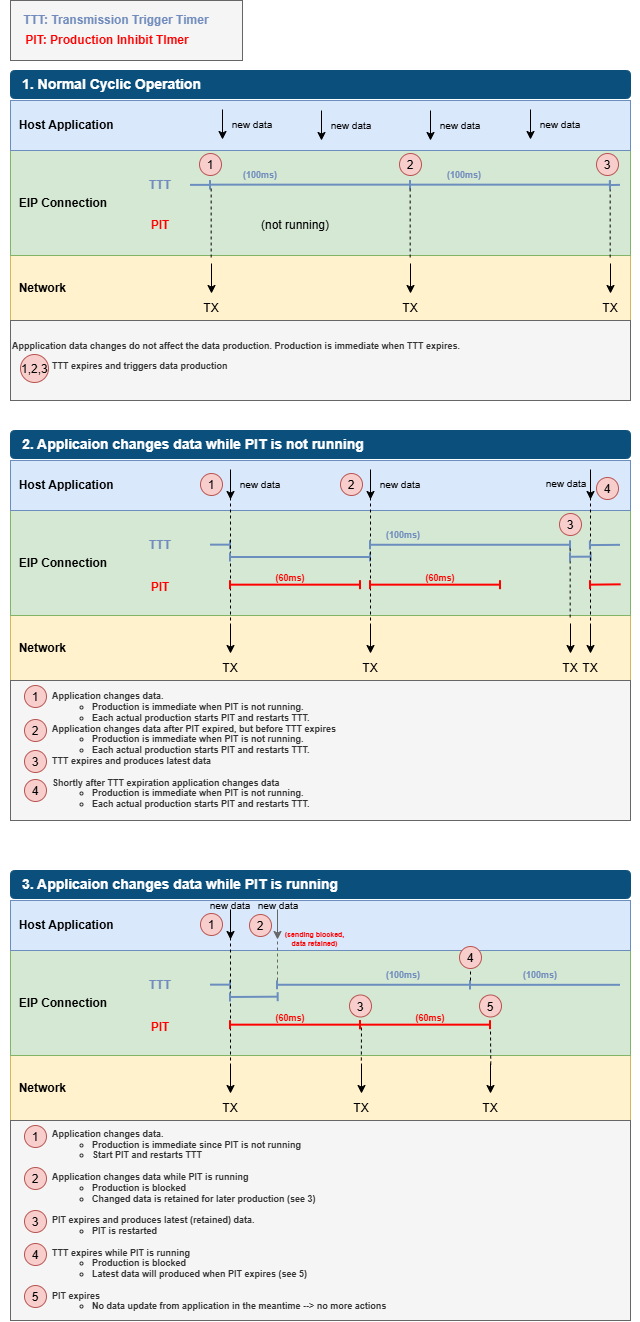
The current Class 0/1 producer timing behavior shows inconsistencies in how application-triggered production, Production Inhibit Time, and periodic transmission triggering interact.
This can cause unexpected produced-frame timing under mixed APP/TTT activity.
Especially the case where the PIT is running and the TTT expires should not trigger message production.
From a product perspective, the core issue is not a single send decision, but the overall timer interaction model:
- Application updates should be rate-limited by Production Inhibit Time.
- Periodic transmission triggering should ensure consumer watchdog continuity.
- Pending data semantics should remain deterministic when updates occur during an active inhibit window.
- Timer behavior should be consistent and predictable under all combinations of APP update, PIT active/expired, and TTT expiry events.
Background:
CIP defines distinct roles for these timing mechanisms:
- Production Inhibit Time provides minimum spacing for application-driven production.
- Transmission Trigger Timer provides periodic trigger behavior to avoid long running silence.
- The combined behavior must remain coherent across edge cases, especially when events overlap in time.
The issue was identified during a timing-model review against CIP Volume 1 and scenario-based event/state analysis.
The implementation needs to be aligned with the intended behavioral model so that produced traffic remains compliant, deterministic, and low-jitter while preserving correct inhibit semantics.
Attachments
Issue Links
- relates to
-
 PSEISV3-992
Update to EtherNet/IP Core V3.10.0.4
-
- Closed
-
-
PSEISV5-586
Update to EtherNet/IP Core V3.10.0.4
-
- Closed
-
- mentioned in
-
Page Loading...